Why Long Surveys Get Careless Answers and What Actually Works
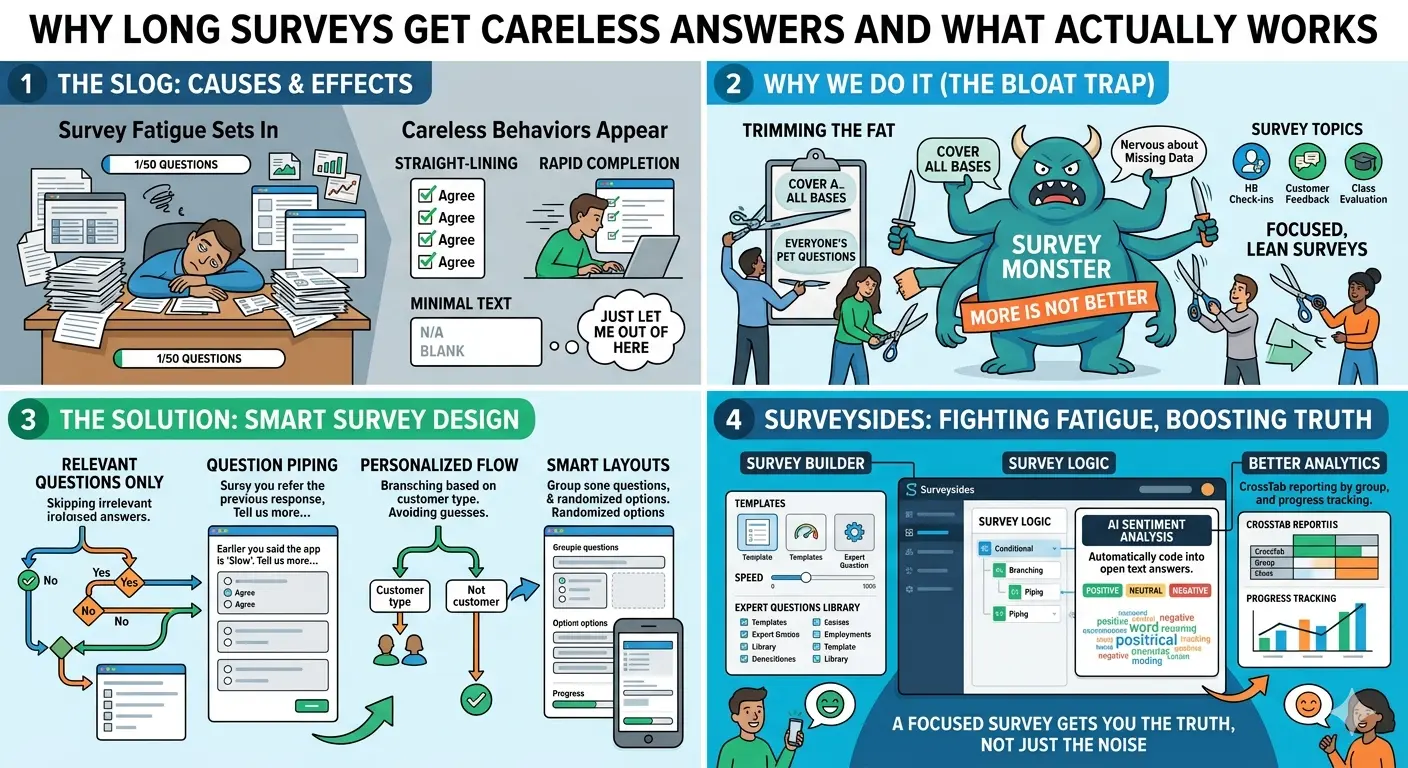
Let's be real: nobody enjoys slogging through a never-ending survey. You start out determined, reading every question, but before long, your motivation starts to dip. Suddenly, you are not thoughtfully weighing each answer. You are just clicking, desperate to finish and get back to your day. When that happens, the data you collect takes a massive hit. By the time people reach the last screen, their answers are not as reliable as the ones they gave at the start.
Typical examples we have seen done as human with more or less no automations from our past experiences.
Example: HR teams capture feedback over an email — they list all questions and shoot an email to required people. HR teams used to wait for results or take manual follow up. Now they have results to be shown to manager/management teams.
Example: Human error scenarios like when they copy paste data to structured Excel, they put it on the wrong pages. Also, the responses received from participants could vary and they might not have returned the same values (i.e. your education background was a question and people replied like MCA / Master of Computer Application / Msc IT / M. Sc. IT etc). This makes their life busy mapping common values.
It is not rocket science. Attention spans do not last forever. You might begin with the best intentions, but after page upon page, fatigue sets in. The longer the survey, the quicker people switch from "let me think this through" to "just let me out of here." That is not because respondents are lazy or uncooperative. It is just how our minds react to tedious, repetitive tasks. It is a human thing.
For starters, there is "straight lining," where someone picks the same option down a whole column. "Agree, Agree, Agree," barely even looking at the questions. Fast completion times are another giveaway. If someone blazes through a 10 minute survey in under 2 minutes, they probably were not paying attention. And when you get to those open ended questions at the end, expect a lot of one word answers or just blank space. Funny thing though, if you ask the same open ended stuff earlier on, you will get more detailed responses. So the placement of your questions makes a big difference.
It usually comes down to trying to cover all the bases. Everyone wants their pet questions added. You feel nervous about missing something important, so another few questions sneak on. There is this belief that more data will make your decisions better, but in reality, you just create a monster people dread. What you really need is a survey that is lean and focused, zeroing in on what actually matters for your decisions.
There is no official magic number, but most research says five to ten well formed, targeted questions on a single topic will get you the best results. If you have to ask more, because sometimes you do, structure matters. Group related questions, make the flow logical, and use branching to send people only to what applies to them.
The best approach is to start at the end. Think about the decision you need help with, and trim away any question that does not serve that purpose directly. Every extra question is a demand for focus and patience your respondents do not have to spare. You get what you ask for, so ask smart.
Good survey logic, for one. Conditional branching means people only see questions relevant to them. If someone has never used your app, do not force them through 10 questions about the user experience. They will either guess or lose trust. By making surveys feel personalized, you keep people interested and get more genuine answers.
You can also use question piping, so the survey refers to something the respondent said earlier. It sounds simple, but it makes the whole experience feel less cold and automated. Randomizing the order of certain questions and response options helps too. It nudges people to read more carefully, and you cut down on mechanical answering patterns.
Everything we do is designed to fight survey fatigue and drive better answers, not just bigger datasets. The survey builder is built for speed, clarity, and focus, loaded with over 100 expert written questions, not just fluff you tack on out of habit. Whether you are running an HR check in, chasing customer feedback, or running a class evaluation, you are starting from proven templates. This keeps things tight and on message, saving you from drowning in an ocean of unnecessary questions.
Conditional logic and piping are standard, so respondents only see the questions that matter to them. It makes even a longer survey feel short, because it is tailored to every person. You also get built in AI sentiment analysis for open text answers, so you can use those genuine comments people leave without spending hours hand coding every response. That is valuable when you are running short surveys but need detailed feedback.
CrossTab reporting makes it easy to see trends by any group you care about, and you can track changes over time, so every survey gets more useful as you go. Anonymous response options make people feel safer, and a gentle, optional IP tracking tool helps cut down repeat or fake entries, without scaring off honest people.
Longer does not mean better. Bloated surveys just pile up weak responses and make life harder for everyone. It is the sharp, focused surveys, the ones that only ask what matters, that get honest, useful feedback.
So keep your surveys lean. Design every question with the end decision in mind. Use logic, and personalize what you can. It is tough to cut questions, but the answers you get are sharper and more actionable.
If you are curious about how Surveysides makes all this easier, book a quick demo. See for yourself how a focused survey gets you the truth, not just the noise.
People's attention drops when surveys drag on. They start coasting, choosing quick, easy options instead of giving real answers. Once the goal becomes finishing instead of thinking, your results take a hit.
Usually five to ten questions, tightly focused on a clear topic. If you need to go longer, keep it organized. Group questions by theme, and make sure people only see what matters to them.
Straight lining is the big one, identical answers down the page. Super fast completions are another. And when open ended answers at the end get short or meaningless, it is a red flag.
It lets people skip questions that do not fit them. Engagement stays up, attention does not drop, and you end up with better, more honest data, without adding unnecessary length.
We use branching and piping to keep surveys relevant. The question bank helps you stick to what matters, and AI sentiment tools draw out useful insights from even short, open ended comments. End result? Everyone gets what they need, useful data, less hassle, and respondents who do not feel burned out.