Why Manual Customer Feedback Collection Is Killing Your Momentum
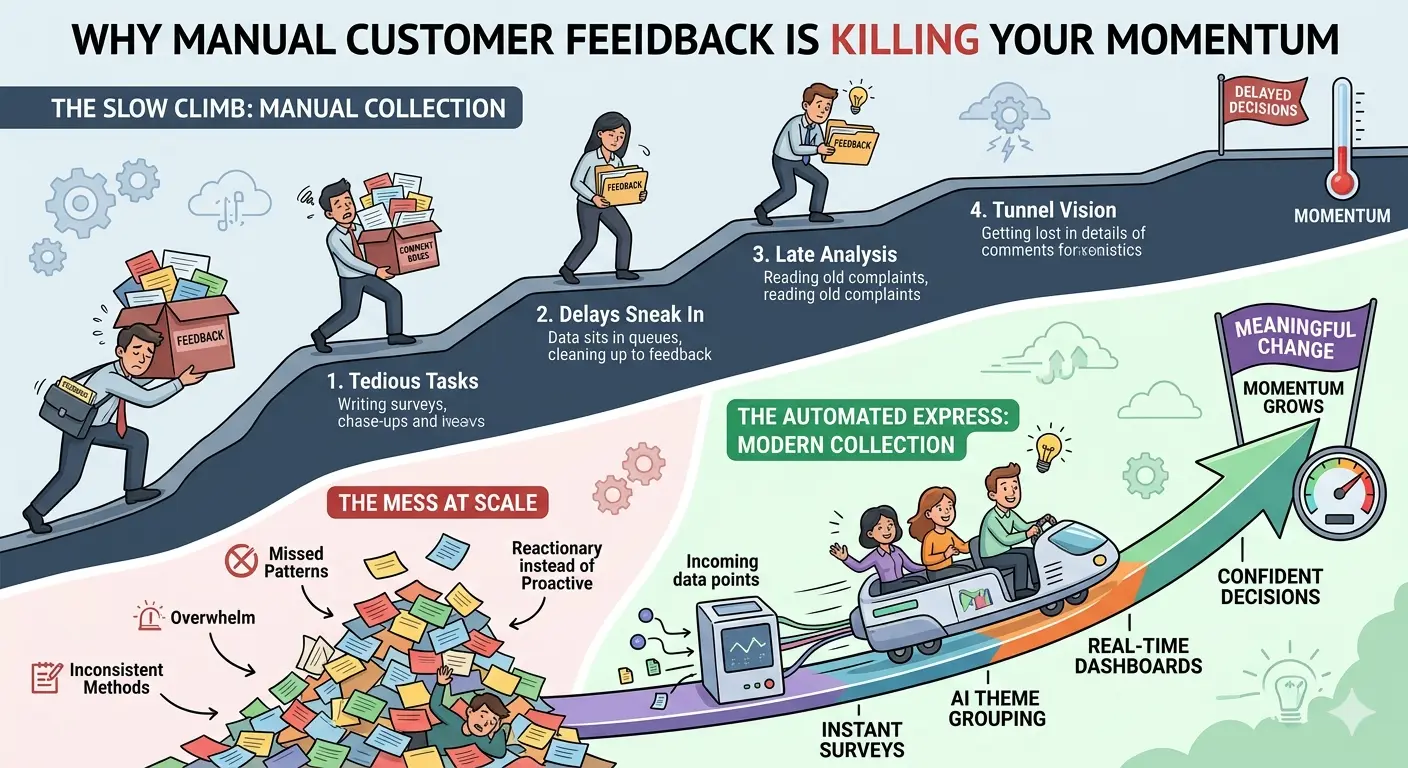
Collecting feedback the old way really bogs your team down. It takes forever to get useful info, drains everyone's energy, and makes spotting trends feel impossible. Instead of guiding your decisions in real time, feedback shows up after the moment has already passed. That is when your momentum just fizzles out.
Because every single piece falls right onto your plate or your team's. Someone has to send out the surveys, chase people for responses, collect the answers, and finally try to make sense of the mountain of data, all before you even start to learn anything from it. None of these steps line up, so everything drags in a slow queue.
Delays sneak in. Maybe you are getting responses, but you cannot do anything with the data yet. By the time it finally gets cleaned up and lands on your desk, the issues people mentioned have probably moved on. You end up with this frustrating gap: you know what your customers are saying, but by the time you are ready to act, it is already old news.
Feedback only makes an impact if it is about what your customers are dealing with right now. If it is slow or outdated, you are not solving today's problems. You are reading about last week's frustrations. Sure, sometimes a complaint sticks around, but that window for quick action closes fast. A small hiccup can snowball into something much bigger just because you missed it in time.
If you are aiming to move quickly, late feedback throws a wrench in the gears.
The bigger the pile of responses, the messier it gets. Ten answers? Fine, you can handle that. A hundred? A thousand? Suddenly it is overwhelming.
You have to comb through each response, try to sort them in some way, and look for big picture patterns. As that pile grows, it all just takes longer and staying on top of things starts to feel impossible. You get two choices. Either obsess over every detail and lose tons of time, or just skim and miss what is really important.
When you are doing everything manually, it is easy to get tunnel vision on individual answers. Reading a comment here and there is okay, but connecting the dots across hundreds is not.
Patterns only pop up if you can group similar feedback together. Without some structure, repeated complaints just sound like random noise, so teams often react to whatever is loudest while the real issues slip right under the radar.
Momentum hinges on quick feedback loops. Hear from your customers, act, and keep moving. Manual processes break that rhythm. Each step gets dragged out, so decisions get delayed. Suddenly, everyone is waiting anxiously for the next report instead of learning and making moves.
It is not just about speed, either. When your data is old or unclear, teams second guess themselves. That hesitation slows everything down even more.
Everyone approaches sorting and analyzing feedback in their own style. One person groups responses by topic, another by tone, someone else by urgency. Same data, totally different outcomes.
Consistency matters. If everyone is doing their own thing, you cannot trust the results to steer your next move.
Automation wipes out those headaches. Surveys go out, responses roll in, and everything gets sorted and analyzed instantly.
No more waiting around for somebody to build a report. Teams see trends as they happen. You can catch snowballing issues before they do real damage and step in while you still have time.
Feedback goes from a slow drip to a steady stream that actually helps you.
Surveysides cuts out the manual work. You can create surveys in a flash with templates and smart questions. No dragging your feet, just action. When responses come back, Surveysides uses AI to analyze sentiment and groups feedback by themes automatically. Instead of slogging through answers one at a time, you get the big picture right away.
Dashboards update in real time. Filter by customer segment, watch trends take shape, and actually understand what is happening across your customer base.
Instead of wasting time getting organized, you are making decisions with confidence.
Speed, honestly. You act on feedback as soon as it comes in.
You do not have to wrestle the data into usable shapes. The patterns are obvious. Now you are focused on building better products and services, not just wrangling responses.
Momentum comes back. You are learning and improving constantly, without those annoying pauses.
Manual feedback collection just blocks your progress at every step. It slows down insight, hides important patterns, and forces decisions to drag.
Automated tools slice through that mess. Feedback turns into something you can actually see, trust, and use right away.
Manual slows you down. Automation lets you keep moving.
You have to do everything yourself. Send surveys, follow up, sort responses, and actually make sense of them. Every step just adds more waiting.
Absolutely. If feedback is outdated, it only warns you about the past. You miss the chance to fix things before they go sideways.
As responses pile up, handling and finding real patterns gets overwhelming. It is a struggle to keep things consistent and spot what matters.
You collect, sort, and analyze the data as it arrives. Insights surface quickly, and you can respond while it still counts.
It handles survey creation, analysis, and reporting automatically. Your team can actually use the feedback. No need to spend time managing it.
Maybe if you only get a handful of responses. But once things ramp up, manual methods just cannot keep pace.